Showing posts with label What's inside a.... Show all posts

Thursday, February 16, 2012

What's inside a Box O' Joe? Project

Some time ago we had a leftover Dunkin' Donuts "Box O' Joe." None of us here drinks coffee, and certainly not in "Box O'" quantities. So, rather than just throwing out the thing, I decided to begin a:

What's Inside a Box O' Joe Project!
The first thing to do was to open the Box:
You'll note that I basically reversed the numbered and illustrated instructions designed for the Dunkin' Donuts employee to follow.

Upon opening the box, I discovered a Mylar bag, which can only be described as a "Sack O' Joe":
The reflective Mylar insulates the Joe from radiative heat loss, and the air inside the Box and within the cardboard walls of the Box insulates the Joe from conductive heat loss.

Before continuing my dissection, I drained the sack to minimize the likelihood of having a Lap O' Joe. I then found that I could peel back the Mylar from an internal plastic Sack:
which holds the actual Joe. I refilled the innermost sack with Joe just to see what it looks like full:

So, there you have it. What's Inside a Box O' Joe!

Wednesday, December 08, 2010

The Whats Inside a Water Fountain Project

The only water fountain in the Mechanical Engineering Department at Rutgers is broken.  It has been broken since the summer.  This has resulted in the water fountains innards being exposed.

The water fountain seems to work exactly as air-conditioners work.  The black container at the bottom is a compressor, which compresses a coolant gas.  The high pressure gas is then run into the condenser which is the fan and radiator on the right side.  The condenser cools the coolant gas that was heated by the compression and allows it to condense into a liquid.  The liquid coolant is then pumped to a evaporator.  I believe the evaporator is inside the cold water storage container, which is at the top of the box insulated by what appears to be Styrofoam.  As the liquid coolant comes to the evaporator it is allowed to evaporate which results in a cooling process.  In much the same way sweat evaporating cools you down.  The gas is then pumped back into the compressor and the cycle repeats.  The cool water then stays insulated and when you push the button is pumped right to you.

Here is a better image of the compressor and condenser.  Additionally, there is a valve on the left side of the image, however I cannot recall if it is on the high or low pressure side of the cycle.

Thursday, October 14, 2010

What's Inside a Fiber Optic Cable? Project


When we moved to Teaneck two years ago (this post has been a long time coming) we had FiOS installed. One of the many things that went wrong that day was them bringing too short of a fiber optic cable, requiring them to cut off the one they started to install. I snagged a piece of the removed and discarded cable and this naturally led to the:

What's inside a Fiber Optic Cable Project!
A fiber optic cable consists of a few parts. Let's work our way from outside-in.

The outside of the cable consists of this stiff, hard and smooth black plastic (polyethylene) casing:
As you can see, this fiber is made by Corning. I actually found what I think is the product page here, along with a spec sheet [pdf]. The outer casing provides a strong outer protective layer.  This is what the cable looks like in cross-section (fingers add some scale):
The straight white segments you see in the first picture and in this cross-section are called "Dielectric Strength Members" in the spec sheet. That basically means "Strong Non-conducting Things."  In this case, they are Kevlar cables.  This stiffens the cable and, by sandwiching the actual fiber in between the two Kevlar things, decreases the likelihood of something damaging the optical fiber.

The next thing in is a soft opaque tube filled with a gooey gel type stuff. This is called a "buffer" and serves as an additional layer of protection for the optical fiber inside.
Here you can see the Kevlar cables and the (thicker white) buffer tube surrounding the the optical fiber.

Well, sort of. First you have the "cladding" -- the blue line in the picture.
Here's what it looks like under a microscope.  The cladding serves both as an additional protective layer, and, since it has a lower index of refraction than the "core" optical fiber, helps the light reflect back into the fiber.  Finally, then, after the plastic, the Kevlar, the buffer, the cladding [the frog, the lights, the armor], we get what's all the way inside the fiber optic cable: The optical fiber itself:
Unfortunately, I don't have a functioning micrometer (or SEM) at home, so I'm not sure how thick the fiber (or fiber+cladding) actually is, but I'd estimate on the order of 100μm [about a hair's thickness].  I could probably compare from the scale of an easier-to-measure thing, but I'm too lazy. Readers: feel free. Anyway, from the spec sheet, that seems about right, too.

And, for the record (lest you think my lack of micrometer at home lowers my scientist "cred"), the microscope images were taken on my dining room table:

Tuesday, October 12, 2010

What's Inside an Ancient Television

Some time ago my Grandmother moved out of her old house and her old TV fell into my hands. This TV was the source of many memories sitting downstairs with my brothers watching something while the adults upstairs talked endlessly. My grandparents had bought this TV around 35 years ago. If you know your history this was withing a couple of years of color TV becoming the standard which means this is one of the oldest models. In comparison to modern TVs this one had terrible image quality and was just plain old. So before we got rid of it I decided to take the back off of my childhood memories... which naturally led to the:

Whats inside an old television project!


With the exception of the cathode ray tube a some resistors and capacitors I really have no idea what most of this components do.


To change the channels on this TV there was a knob (no remote) and it would go clunk. The power button also went clunk.

Sunday, October 10, 2010

Whats Inside a Microwave Project

So I burnt a potato in the microwave once - - - when I say burnt I mean it actually caught fire and filled the microwave with smoke so thick it darkened the inside so much I thought it was off (even though the light was on inside!) The microwave was so roasted and toasted inside that it was time to get a new one . . . which naturally led to the:

Whats inside a microwave project!

Most parts of the microwave are pretty boring, like the fan motor here and capacitor (kind of big actually).

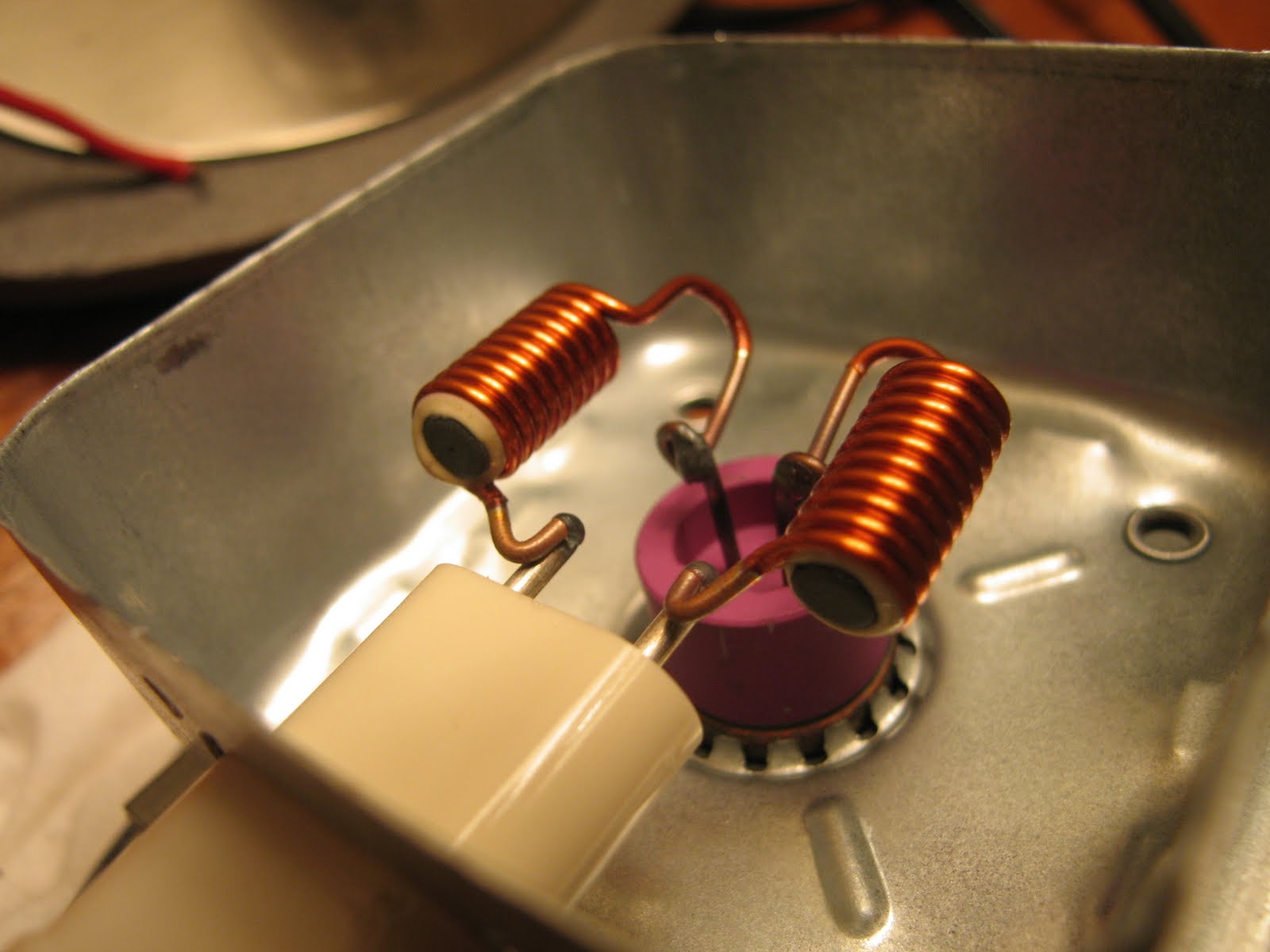
This is the part where the electricity comes into the heart of the microwave, sometimes called the "Magnetron." That is where the microwaves are generated. Here is a great website about how magnetrons work, from which I have stole this diagram below,


and this is the thing itself!


The magnets are quite awesome, now gracing my fridge. Not really sure what the gold looking foil is about...

Magnetron sans magnets.

and lastly a look inside the most inside you can get in a microwave.

Thursday, April 29, 2010

What's Inside a Box-spring? Project

Since we moved to our house two summers ago, we've had a queen-size box-spring (which didn't fit up the stairs to our bedroom) living in the guest room:
(Everyone say hi to Widget!)
Aside from the fact that this thing didn't really add to the decor, the kitties used it as their own personal (auxiliary) scratching post:

So, a few weeks ago it was time for it to go.  It would be a waste to just throw it out (and believe me, we tried giving it away a number of times), so, instead, Aryeh and I decided to dissect it.  And thus,
What's Inside a Box-spring? Project:
First we laid the subject upside down and peeled off the soft underbelly.

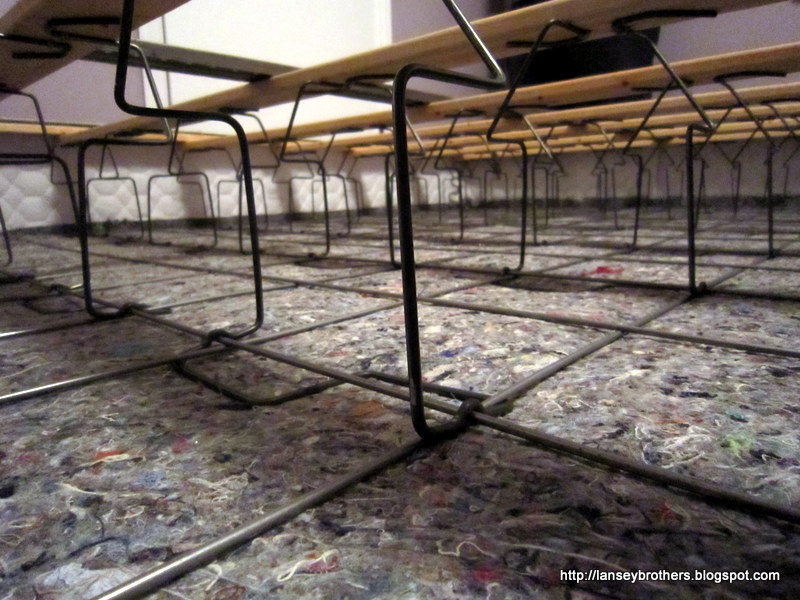
 This exposed the cool underlying structure:
As you can see, there's a wooden framework of ribs which the springs are attached to, as well as a metal backbone for support.

We then skinned the beast:
As you can see, there are two layers of skin.  A tough external skin layer with a soft mushy tissue layer underneath.  This lower layer of tissue is actually pretty cool.  It's made of a network of fibers:


After skinning, and short rest
we broke off the metal backbone and side ribs.  This left a strong, and flexible (in one direction only) contraption:

We then studied the springs.  Here's a close-up of one of 'em:
We then broke one spring off (saved for posterity, of course), and decided it would be too much work to break them all off, so we brought the remains of the box-spring out to the street for garbage collection:

Oh, and this was there the whole time, watching...
So you know what that means... Time Lapse!

Thursday, November 20, 2008

What's Inside a Diaper? Project

We have some left over, fairly low quality [i.e. leaky], WalMart-brand diapers (White Cloud and Parent's Choice) in a size too small.  So I figured that it is time for...a Science Experiment!
I chose one diaper, and prepared the specimen for dissection:

After some preliminary incisions to remove some connective tissue, I was able to peel back the outer layer, revealing the inner guts of the diaper:

This flaky, dusty, papery, almost cotton-like material was laced with little beads:

Upon addition of water, I noticed two phases of absorption.  First there was a rapid, although weak absorption by the papery stuff.  This was followed by the second, stronger, slower absorption phase when the beads started taking up the water.
This two-stage method is fairly clever, and efficient in vivo.  The first step rapidly pulls the, well, "moisture" away from the, erhm, "source," decreasing the likelihood of instant leaks, while the second phase stores the "moisture" well for a longer period of time, thus allowing the source's "handlers" to sleep a little bit longer.

But just how much moisture can these things hold?
The dry weight of the absorbent part of the diaper is around 20 grams.  I added water until it just stopped absorbing:
The added weight of the absorbed water was around 600 grams (and the absorbed volume was similarly around 600 ml).  So, the diaper can hold around 30 times its weight in fluid.  (And these are the cheap diapers!)  I was pretty impressed.
Here are the beads at near-full absorbency:

We still have a bunch of these diapers left, so if there are any further experiments you'd like to see, please let me know in the comments.

And now you know What's Inside a Diaper.  Aside from the obvious, that is.